
| ⚠️ You should consider inpatient mental health treatment when your body is at risk or withdrawal is unmanageable. If you’re having suicidal thoughts, depressive episodes, self-harm, psychosis, mania, or feel danger, then call 988 or 911, or go to the nearest ER. |
Sometimes darkness becomes your only comfort place, and your thoughts become deeper than they used to be. Maybe your body is in survival mode for too long, or you didn’t even notice its symptoms.
Inpatient mental health treatment isn’t a cage; it’s a rehab facility where a spark of hope ignites again within a safe environment. This level of care is available to you or your loved ones so you don’t have to carry everything on your own. This allows you to recover while you go back home or meet your family.
In this guide, you will learn how inpatient care works and what makes it different from other treatment plans. So why wait? Reach out to our NYC Rehab to learn more about our clinically approved programs.
What Is Inpatient Mental Health Treatment?
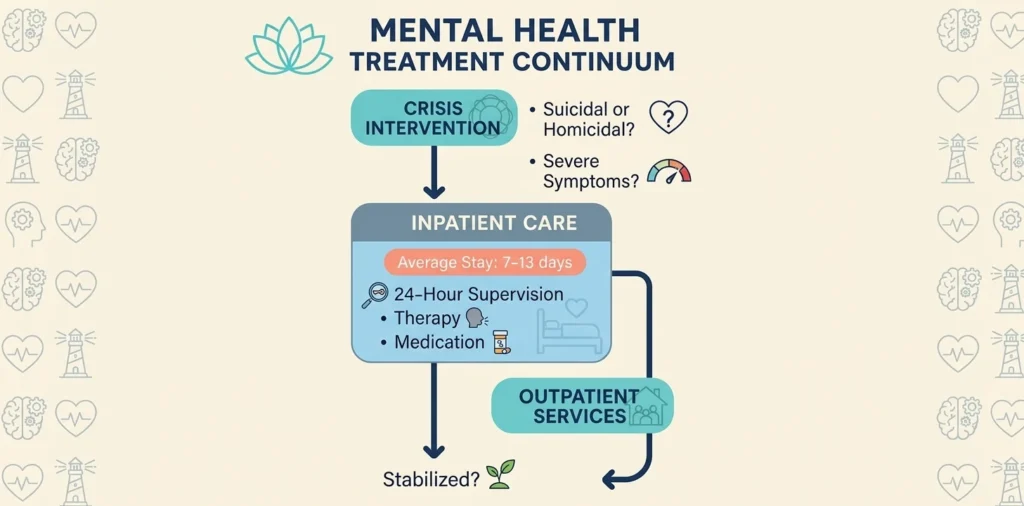
Inpatient mental health treatment provides 24/7 psychiatric care within a hospital or rehab facility under licensed doctors.
Patients can stay in a safe & secure environment in rehab while an expert team manages underlying root causes, stabilizes acute symptoms, provides medication, and gives an ongoing customized plan. The word “inpatient” means you’re admitted onsite at a specific rehab or place. It differs from an outpatient program, where you can attend sessions and then go back home or to work.
| What is Inpatient Treatment? Medically In medicine, inpatient treatment means any treatment plan that requires formal admission to stay overnight for surgery, cardiac care, or mental health issues. It is generally categorized into two settings: 1. Acute inpatient psychiatric hospitalization (short-term hospital-based program) 2. Residential treatment (long-term, live in treatment facility) |
Recognizing the 9 Signs and Symptoms That Indicate the Need for Inpatient Care
Deciding when you need inpatient psychiatric care is the most important step. Doctors decide on inpatient admission around these three core questions. Does this person feel safe on their own? When to seek inpatient treatment for depression or anxiety? Can their symptoms be managed in outpatient or residential care? So let’s start digging deeper to know these answers.
1. Suicidal Thoughts With a Plan, Intent, or Recent Attempt
Are you having any passive thoughts like “I should take pills,” or ” I wish I weren’t here”? These thoughts are okay at first, but they will cause serious damage in the end.
2. Self-Harm That Is Escalating or Medically Serious
Self-harm or cutting your veins is a common coping way people use when their emotions are overwhelmed. Inpatient care becomes necessary when such mental illness happens that leads to a suicide attempt.
3. Urges or Plans to Harm Someone Else
Intrusive thoughts that horrify you (common in OCD), its different from self-harm. Such thoughts make you do risky acts toward violence or harm someone else’s life because you’re not happy with yours.
4. Psychosis: Hallucinations, Delusions, or Severe Paranoia
Hearing voices, seeing random unrealistic events, or believing in false situations that your mind creates can cause serious damage to your brain. A first episode of psychosis almost always warrants urgent psychiatric evaluation, because early treatment strongly shapes long-term outcomes.
5. Mania or Severe Mood Instability
It looks like sleepless nights for several days, uncontrollable spending habits, sexual risk-taking activities, or fast, rough driving without considering their consequences. Hospitalization is most needed to stabilize the body and restart life without further damage.
6. You Can No Longer Take Care of Basic Needs
Clinicians sometimes call this grave disability, and it is also a legal standard for involuntary care in many states. Signs include:
- Loss of appetite (not regular eating or drinking)
- Not taking necessary medication (psychiatric, not even multivitamins)
- Unhygienic routine, not taking baths, irregular sleep cycle
- Not going with friends or family for days to weeks
- Being unable to maintain safe housing
7. Severe Depression That Has Stopped Responding to Treatment
When depression or anxiety reaches its peak stage, your body stops functioning normally even if your medication doesn’t provide you with any relief. With inpatient care, you can heal faster with medication and counseling under 24-hour observation.
8. Outpatient or Lower Levels of Care Haven’t Worked
If you already tried outpatient care every week and it didn’t work, and you’re still in crisis, ending up in the emergency room. That pattern tells you need team care.
9. Mental Illness Combined With Substance Use or Medical Risk
Dual diagnosis or any co-occurring conditions make everything harder to treat. Like if you already have alcohol addiction with anxiety attacks, it not only triggers your physical health but also makes your mental health worse, triggered by stimulants. These situations often need medically supervised inpatient care.
Go Now, Call Today, or Book an Assessment. Don’t Delay Your Recovery
Call 988, your psychiatrist, or an inpatient facility’s 24/7 admissions line for a same-day assessment
Do I Need Inpatient Treatment? The SAFE Check
Use this four-question self-check for yourself or someone you love. It isn’t a diagnosis. It’s a structured way to put words to what you’re seeing before you talk to a professional.
| Letter | Question | Answer “yes” if… |
| S — Safety | Is anyone at risk of being hurt? | Suicidal thoughts with a plan, self-harm, violent urges, or reckless behavior |
| A — Ability to function | Can basic self-care still happen? | Not eating, sleeping, bathing, taking medications, or getting out of bed |
| F — Failed lower levels | Has less intensive care already been tried? | Weekly therapy, medication changes, or IOP/PHP haven’t stabilized symptoms |
| E — Environment | Is home a safe place to recover? | Home is unsafe, chaotic, isolating, or full of triggers (including access to substances or means of self-harm) |
When to Seek Inpatient Treatment for Anxiety
Anxiety disorders with panic attacks can be manageable in outpatient treatment unless they lead to suicidal thoughts or attempts. We use therapeutic approaches (especially CBT and exposure-based therapy) with medication-assisted treatment to heal properly.
Consider inpatient or residential care for anxiety when:
- Frequent panic attacks (hard to leave house or for work)
- Anxiety leads to suicidal thoughts or even attempts
- Your eating, sleeping, or normal routine function is badly disturbed due to anxiety
- Severe OCD consumes hours a day, and outpatient treatment doesn’t show any good progress
- PTSD symptoms such as flashbacks, dissociation, or hypervigilance are making daily life unmanageable
- You’re dependent on substance abuse or alcohol to cope with your stress or anxiety and to feel pleasure.
| Warning: Taking benzodiazepines or opioids temporarily and then abruptly stopping them will cause severe withdrawal symptoms, which are only manageable under residential inpatient care. |
Who Needs Inpatient Mental Health Care?
According to AHRQ’s Healthcare Cost and Utilization Project, they account for roughly 82% of mental health hospital stays.
Acute inpatient rehab care improves internal body mechanisms and provide mentally freedom to think positively. Only diagnosis can’t decide it, as two people with the same diagnosis but different severity can’t take the same level of care. These patients need immediate help and admission.
Condition
- Major depressive disorder
- Bipolar disorder
- Schizophrenia and psychotic disorders
- Severe anxiety, OCD, PTSD
- Borderline personality disorder
- Co-occurring substance use disorder
- Eating disorders
Levels of Care Compared
Mental health care works as a continuum.
| Level of care | Where you sleep | Hours of treatment | Typical length |
| Acute inpatient hospitalization | Secure hospital unit | 24/7 supervision | About 5–10 days |
| Residential treatment | Live-in facility (home-like) | 24/7 structure, therapy most of the day | About 30–90 days, sometimes longer |
| Partial hospitalization (PHP) | Home | About 5–6 hours/day, 5 days/week | 2–4 weeks |
| Intensive outpatient (IOP) | Home | About 3 hours/day, 3–5 days/week | 6–12 weeks |
| Outpatient therapy | Home | 1 hour/week or so | Ongoing |
What Happens in Inpatient Mental Health Treatment?
The fear of “what will happen if I join rehab”, “do I need residential treatment for my emotional support,” or “am I too mad to take this kind of treatment” may arise, but considering taking help is a courageous step. Here is what actually happens..
Admission and Intake (Day 1)
- Screening
- Medical check
- Belongings search for self-harm items
- Psychiatric evaluation
- Treatment plan
A Typical Day on an Inpatient Unit
| Time | Activity |
| 7:00–8:00 AM | Wake-up, vitals, medications, breakfast |
| 9:00 AM | Community meeting (daily goals) |
| 10:00 AM | Group therapy (CBT or DBT skills) |
| 11:00 AM | Meeting with psychiatrist and treatment team |
| 12:00 PM | Lunch |
| 1:00–3:00 PM | Psychoeducation, art, music, or recreational therapy |
| 3:00 PM | Individual therapy or case management |
| 5:00 PM | Dinner |
| 6:00–8:00 PM | Visiting hours, phone time, wellness activities |
| 9:00–10:00 PM | Evening medications, wind-down, lights out |
Rules You Should Expect
- Safety checks, sometimes as often as every 15 minutes
- Limited phone and device access for specific duration
- Set visiting hours
How Long Is Inpatient Mental Health Treatment?
It depends on the severity and condition of the person, but it usually takes around a 5-10-day stay. According to AHRQ national hospital data, the average length of stay for mental health issues is about 8 days, or a maximum of 14 days.
Therapies & Clinical-Approved Residential Treatment for Mental Health
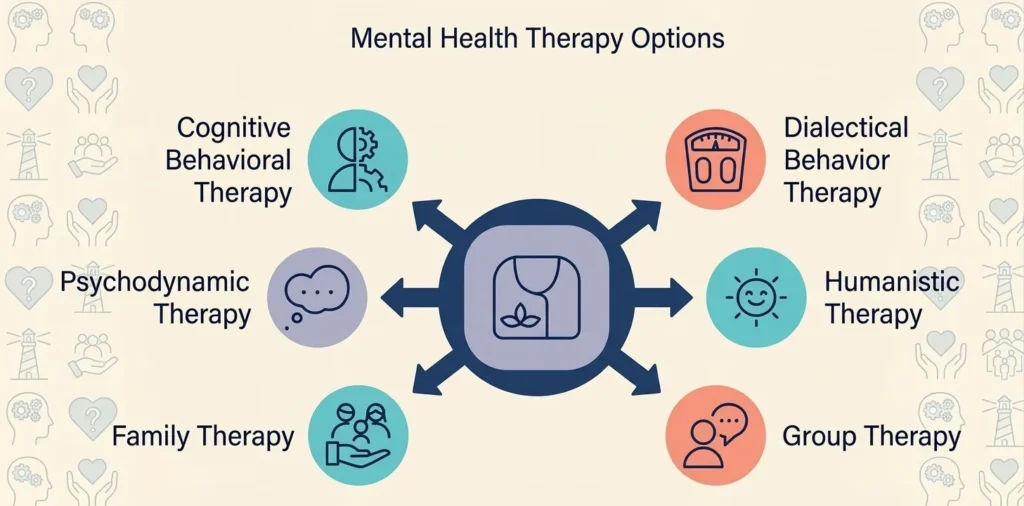
If we talk about substance abuse, trauma, eating disorders, or other co-occurring disorders, such conditions require a longer stay. Some adolescent programs last for 30 to 90 days, depending on their addiction, dependency, or mental health status. Our registered doctors used CBT, MI, couple therapy, group & individual therapy, dialectical behavior therapy, and EMDR.
Benefits of Inpatient Mental Health Treatment (and Honest Limitations)
There are numerous benefits that inpatient facilities provide you so you can heal properly without external triggers.
- Immediate safety
- Faster medication adjustments.
- Diagnostic clarity
- A break from triggers
- Treatment density
- Coordinated discharge planning.
- Peer connection
The Honest Limitations
| Limitation | How good programs address it |
| Short stays don’t resolve long-standing issues | Structured step-down to PHP, IOP, or residential care |
| The locked setting can feel restrictive | Clear orientation, patient rights education, a respectful environment |
| Time away from work, school, or family | FMLA and ADA protections; family sessions; school and work letters |
| Post-discharge transition is high-risk | Follow-up within 7 days, safety planning |
How to Help a Loved One Who Needs Inpatient Care
- Ask directly about suicide. Asking “Are you thinking about killing yourself?” does not plant the idea. It opens the door.
- Stay calm and specific. Say “I’ve noticed you haven’t eaten in three days, and I’m worried,” not “You’re acting crazy.”
- Know the limits. You can’t admit an adult yourself. If they refuse and are in danger, call 911 or 988, or contact your local mobile crisis team.
- Take care of yourself, don’t take any risks, and make an action plan asap.
How Much Is Inpatient Mental Health Care?
The cost of inpatient mental health care varies based on factors such as region and treatment choices. Each rehab offers different ranges with insurance coverage, starting at several thousand dollars.
Several factors impact cost:
- Location
- Length of treatment service
- Type of treatment
- Insurance coverage plan
Find Inpatient Mental Health Treatment Centers Near You
Our NYC rehab takes an overall body assessment and your psychiatric history to customize your treatment plan according to your body’s needs. Whether you need inpatient care, outpatient flexibility, or ongoing support, we’re here to help you.
Accessing Help and Support Resources
Our NYC addiction recovery center provides healthcare services and mental health assessments to help you regain your freedom. This rehab offers 24-hour inpatient admission for everyone who is looking for same-day admission and flexible treatment support.
By clicking on the “Contact us” button, our compassionate staff will reach out to you and guide you through every stage of recovery.
Frequently Asked Questions
When should you go to an inpatient mental health facility?
When you feel that your body doesn’t feel safe or is not functioning properly, that includes suicidal thoughts, self-harm, mania, loss of appetite, and symptoms that outpatient care can’t control.
What symptoms will get you admitted to a mental hospital?
There are proper admission criteria that assess a patient’s mental health if they are having suicidal thoughts, psychosis, mania, or grave disability. If someone doesn’t care for their own needs, then they may need medical help.
Is residential treatment considered inpatient?
Residential treatment is live-in, so it is inpatient in a general sense. It is, however, a separate, less acute level of care than hospital-based psychiatric inpatient treatment. It usually lasts weeks to months and takes place in a more home-like setting.
Will I lose my job if I go to inpatient treatment?
No, Federal laws such as the FMLA and ADA protect your rights while you’re taking treatment. If you’re eligible for their term, and even if you don’t have to tell your colleagues about it, a doctor’s note is enough for this.
How do I help a family member who refuses inpatient treatment?
Don’t force them to join rehab or leave the house; deal with them calmly. Show genuine concern about their health and offer to go for an assessment at first. But if they’re in danger and still refuse, then call 911 or 988, or contact any rehab near you.