
Evidence-based opioid addiction treatment in New York that provides medical detox, Suboxone and MAT, therapy, and aftercare. We accept most insurance plans, with confidential help available 24/7.

Opioid addiction, clinically called opioid use disorder (OUD), is a chronic phase where a person keeps using opioids even after their harmful effects. Taking drugs repeatedly rewire the brain’s reward and stress system, so stopping triggers withdrawal effects.
We provide customized medical care with a therapeutic approach that leads to long-term sobriety. Our expert clinicians provide CBT, family therapy, art therapy, and medication-assisted therapy. Cutting back the use of drugs needs professional help, alone, willpower can’t get you to sobriety.
We applied a full continuum level of care with a holistic approach so our medication stabilizes the body for recovery. Not one part alone works well. Our inpatient program provides a trigger-free environment and professional staff.

Opioid misuse involves taking this drug as a painkiller medication in a higher dose without telling a doctor or taking someone else’s opioid to get a euphoric high. This improper use causes serious alterations to brain cells that lead to opioid use dependency. If it is left untreated for a long duration, its addiction chances increase, which eventually causes respiratory failure.
Its attach to the brain’s central nervous system to block pain signals while giving dopamine a high. Short-term effects include:
Prolonged exposure leads to increased tolerance, severe constipation, hormonal disruptions, and a high risk of life-threatening respiratory depression.
CDC provisional data show opioid-involved deaths dropped from about 55,300 in 2024 to about 44,600 in 2025.

You don’t need to have all symptoms to get help. Even only two or more is enough to tell you it’s an alarming situation. A proper clinical assessment is worth your time.
Signs in yourself
Our admissions team answers 24 hours a day, and most people are assessed within a day of calling.
The right level depends on withdrawal risk, medical and mental health needs, and how safe your home environment is. Most people move through more than one.
| Level of care | Typical length | Where you sleep |
|---|---|---|
| Medical detox | 5–10 days | On site, 24/7 medical monitoring |
| Residential / inpatient | 28–90 days | On site |
| Partial hospitalization (PHP) | 2–6 weeks, 5 days/week | Home or sober living |
| Intensive outpatient (IOP) | 6–12 weeks, 3–5 days/week | Home |
| Outpatient + MAT | Months to years | Home |
Our IOP program for alcohol addiction or other substance abuse daily day or week looked like this
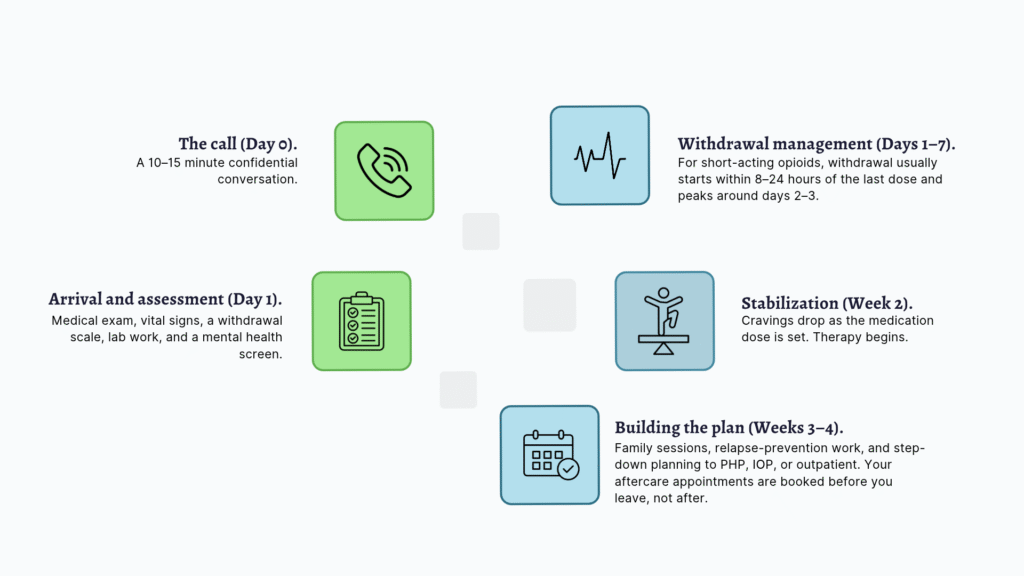
Opioid use disorder (OUD) is a chronic medical condition in which a person continues using opioids despite clear harm.
Common signs include taking more than intended, withdrawal symptoms between doses, switching from pills to heroin or fentanyl, and pulling away from family or responsibilities.
For short-acting opioids like heroin, fentanyl, or oxycodone, symptoms usually start 24 hours after the last dose, peak around days 2–3, and ease within 7–10 days.
Withdrawal is rarely fatal by itself, but severe vomiting and diarrhea can cause dangerous dehydration.
The most effective approach pairs an FDA-approved medication such as buprenorphine, methadone, or naltrexone with behavioral therapy.
No. Suboxone is taken at a stable prescribed dose that controls cravings without producing a high.
Detox typically takes 5–10 days, residential programs 28–90 days, and PHP or IOP several weeks to three months.