
| Quick Answer THCA can remain detectable in urine for more than 30 days after your last dose or drink, while it can remain in blood for up to 36 hours and in saliva for 24-72 hours. Does THCA show up on a drug test? Yes, when it gets smoked or vaped. It metabolizes or converts THCA into THC; full detection breakdown below. |
Wondering how long THCA stays in your system? Whether you’re finding answers so you can prepare for a job screening, have faced any legal issues, or just want to know your health status, first understanding its detection window is important.
When taking THCA in raw form, due to its psychoactive nature, only some tests, like urine tests, detect its trace for up to 30 days. The detection window entirely depends on body metabolism, usage, method used, or duration. Knowing what THCA is and its detection timeline helps you avoid unwanted surprises and reach your goal with our substance abuse treatment.
What is THCA?
Tetrahydrocannabinolic acid (THCA) is a non-psychoactive chemical compound found in raw and fresh cannabis plants. When it is exposed to heat in the form of smoking, vaping, or cooking, it converts THCA into THC.
It’s available in various forms
- Raw flower (primary)
- Tinctures
- Capsules
- Edible products
- Over-the-counter form
These products are mostly classified as cannabinoids and are promoted for their anti-inflammatory, neuroprotective, and antiemetic properties. However, these positive aspects are small when compared with their long-term side effects.
How is THCA Processed in the Body?
THCA is processed in the body through the body’s digestive system when taken in fresh or raw form. THC doesn’t give psychoactive effects until it is heated. After heating, this compound, or being exposed to heat in the form of smoke, vape, or cooking, undergoes a “decarboxylation” reaction. It’s the active compound that causes “high,” named “THC.”
After THC conversion, it further breaks down into various metabolites in the liver, including 11-OH-THC and THC-COOH. Then it circulates into the bloodstream and is excreted as toxins through feces or urine.
What are the Factors That Influence THCA Detection Time?
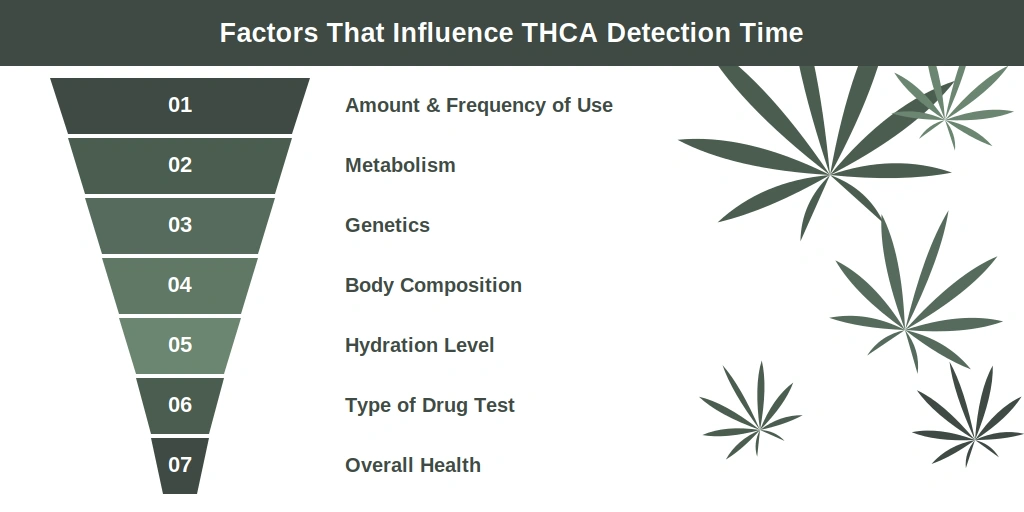
The body’s composition, amount used, frequency, metabolism, genetics, and test type play an important role in the detection timeline for THCA. These factors can give a proper proportion to know how long THCA lingers in your system.
- Amount used: Larger doses may extend detection windows
- Metabolism & Genetics: Faster metabolism genes clear the body of cannabinoids through urine or feces
- Body Fat Percentage: THCA metabolites are fat-soluble, it will accumulate in fat cells longer than usual
- Hydration & Health: Good hydration is equal to good elimination of toxins via urine
- Type of Drug Test Used: Detection windows vary by test type
Is THCA Addictive?
No, it’s not highly addictive, as it doesn’t carry any psychoactive effect to activate the brain reward system, while THC is addictive due to its addictive nature. So if users take heated THC through vapes or smoking, then it leads to dependency. In these cases, it is hard to resist the urge to take it, which can lead to withdrawal symptoms and psychological cravings.
Struggling with THCA and Cannabis Cravings? Contact NYC Rehab Recovery for Confidential, Expert Treatment
How Long Does THCA Stay In Your System for a Urine Test After Quitting?
THCA stays in your system for up to 30 days as 65-80% excreate through feces. In a urine test, the detection window is mostly 3 to 15 days for non-regular users, while it is 30 days for regular users. These timelines for duration entirely depend on different factors of use, like frequency of use, body metabolism, fat cells, hydration level, or overall health.
What Tests Are Done to Detect THCA In the Body in NYC?
These are some tests used to detect THCA in the body through hair, urine, and blood tests. Each test result varies depending on the purpose of the test, detection window, and medical monitoring.
| Test Type | Detection Window | Primary Detection Focus | Common Use Cases |
| Urine Testing | 3 to 15 days (occasional users) Up to 30+ days (chronic users) | THC-COOH (metabolite of THCA) | Workplace screening, routine drug testing |
| Blood Testing | 1 to 3 days (up to 72 hours) | THCA & active THC in the bloodstream | Detecting recent exposure, accident investigations |
| Hair Testing | Up to 90 days or more | THCA metabolites in hair follicles | Legal cases, forensic investigations, long-term monitoring |
| Saliva Testing | Within minutes up to 24 hours | Oral fluid cannabinoids (THC / THCA) | Roadside testing, immediate post-incident screening |
| Breath Testing | Ultra-short window (typically a few hours post-use) | Recent Delta-9 THC vapor / molecules | On-site sobriety testing, law enforcement roadside checks |
Can Breathalyzers or Roadside Tests Detect THCA?
Breath drug usualluy don’t detect THCA. These devices, such as breathalyzers or roadside tests, are only used to detect the active ingredient “THC” in exhaled air.
If a user uses raw THCA, the test comes back negative and is not triggered. But on the other hand, if a user takes it in the form of vaping or smoking, then it converts into THC, and in this way THC can be detected for a shorter period, up to 3 hours.
| Key Takeaway Raw or fresh THCA is non-detectable to these breath test, but can be detected once it is taken with heat. |
What Is the Half-life of THCA?
The half-life of THCA usually refers to the time it takes for half of the substance to be excreted from the blood circulatory system. THCA’s lifespan is shorter than its active compound.
A short lifespan usually means that something can be cleared in a shorter duration than others, such as if a drug gets cleansed out of the blood and saliva quickly, and it delays its detection timeline in other tests. While, as it’s fat-soluble, its hair or urine test detects it better in the longer run. So detection time and window totally depend on the use of the test.
Are There Withdrawal Symptoms With THCA?
No, as it’s a psychoactive compound, it doesn’t bind with any receptors, while THC does bind and shows minimal symptoms. These symptoms include irritability, depression, anxiety, insomnia, low appetite, and mood swings. These withdrawal symptoms only come with THC (ACTIVE form of THCA) and begin to show signs within 24 hours; the peak timeline is 2 to 6 days, and they resolve within a week with a medical detox.
How to Get Treatment for THCA in NYC?
You can’t get treatment on your own; you need to seek professional help near you that focuses not only on physical but also on mental health. These rehabs provide evidence-based programs that heal internally and tackle rootcause reason to recover your health.
No matter if you’re an occasional user or on the edge of developing a severe addiction, NYC Rehab provides various services to provide safe detox and long-term sobriety.
Our Treatment Approach with Evidence-based Thearpies
Our substance Abuse program provides a combination of therapeutic approaches, including around-the-clock supervised care, counseling, ongoing support, and family therapy, or whatever suits you most according to your condition.
Here are the THCA treatment options in NYC:
- Medical Detox
- Residential Treatment
- Dual Diagnosis Treatment
- Aftercare.
- Rehab for Professionals
Overcome THCA Dependence with NYC Rehab Recovery’s Personalized Treatment
Our comprehensive residential or outpatient program, combined with clinically approved behavioral therapies, helps you break free from dependency.
Is THCA considered a drug?
THCA itself is nonaddictive due to its psychoactive nature. Under several federal laws, it’s considered a drug because it is metabolized like its active form, THC
How long does it take to clean out your system fully?
To deeply cleanse from this might take 30-90 days, so the user is free from its mental or physical dependency completely.
Is 3 days enough for detox?
No, usually in 3 days only saliva or blood can be detoxed in occasional users, but regular users take more time.
What is the fastest way to flush your body?
The fastest and safest way to get toxins out of your body is hydration with physical activity and meditation sessions. When body fat cells are lost, they will eventually get out of the body.
How long does weed stay in your blood?
Cannabinoids typically remain detectable in blood for 1 to 3 days post-use, though heavy daily users may show positive results for up to 7 days.